





If the past two years have taught the media technology sector anything, it is that resilience alone is no longer enough. Adaptation – fast, deliberate and sometimes uncomfortable – has become the defining leadership skill of the moment.
As the industry arrives in Barcelona for ISE 2026, there is a growing sense that we are no longer simply recovering from the challenges of 2023 and 2024, but actively redefining what the future looks like. Economic headwinds, labour disruption and geopolitical uncertainty forced many organisations into defensive positions. Yet those same pressures have accelerated a broader rethink of markets, customers and routes to growth.
ISE now sits at the centre of that rethink.
A convergence point
Once viewed primarily as an AV-centric event, ISE has rapidly become a convergence point for broadcast, media technology, enterprise and live experiences. For many vendors who historically focused their attention on IBC or NAB, the show now represents something far more strategic: a gateway to new verticals, new buying behaviours and fresh commercial models.
That shift did not happen overnight, but by the second half of 2025, it became impossible to ignore. As we entered 2025, the prevailing mood across the media technology, broadcast, and sports production ecosystem was one of cautious optimism.
The previous two years had been undeniably tough. The combined impact of macroeconomic pressure, reduced capital expenditure, and the aftershocks of the 2023 Hollywood strikes left many organisations operating defensively throughout 2023 and 2024. Budgets were scrutinised, hiring slowed, and strategic initiatives were often postponed rather than progressed.
Yet 2025 began with hope, a sense that the worst might be behind us. That optimism, however, was quickly tempered. Geopolitical instability, renewed discussions around tariffs, and broader economic uncertainty caused many businesses to pause once again during the first half of the year. Decisions were delayed. Investment hesitated. Pipelines lengthened.
Then something shifted. By the latter half of 2025, momentum returned, not explosively, but meaningfully. Having attended key industry events from IBC in September, to NAB New York in October, to DPP Leaders in November, and finally the SVG Summit in December, one consistent theme emerged: cautious optimism was creeping back in.
Vendors, in particular, shared a similar refrain. While many acknowledged they might not fully hit the ambitious targets set at the start of the year, results were materially better than initially feared. More importantly, pipelines were rebuilding, conversations were flowing, and strategic intent was returning.
This re-emerging confidence has set the tone for 2026, and nowhere is that more evident than at ISE.
Broadening horizons
One of the most significant outcomes of the past two challenging years has been a forced, and ultimately healthy, reassessment at the senior leadership level.
For decades, many technology vendors built their businesses around a familiar set of customers: broadcasters, media networks, studios, production companies, and post-production facilities. But the realities of 2023–2025 made it clear that relying too heavily on a narrow set of verticals creates vulnerability.
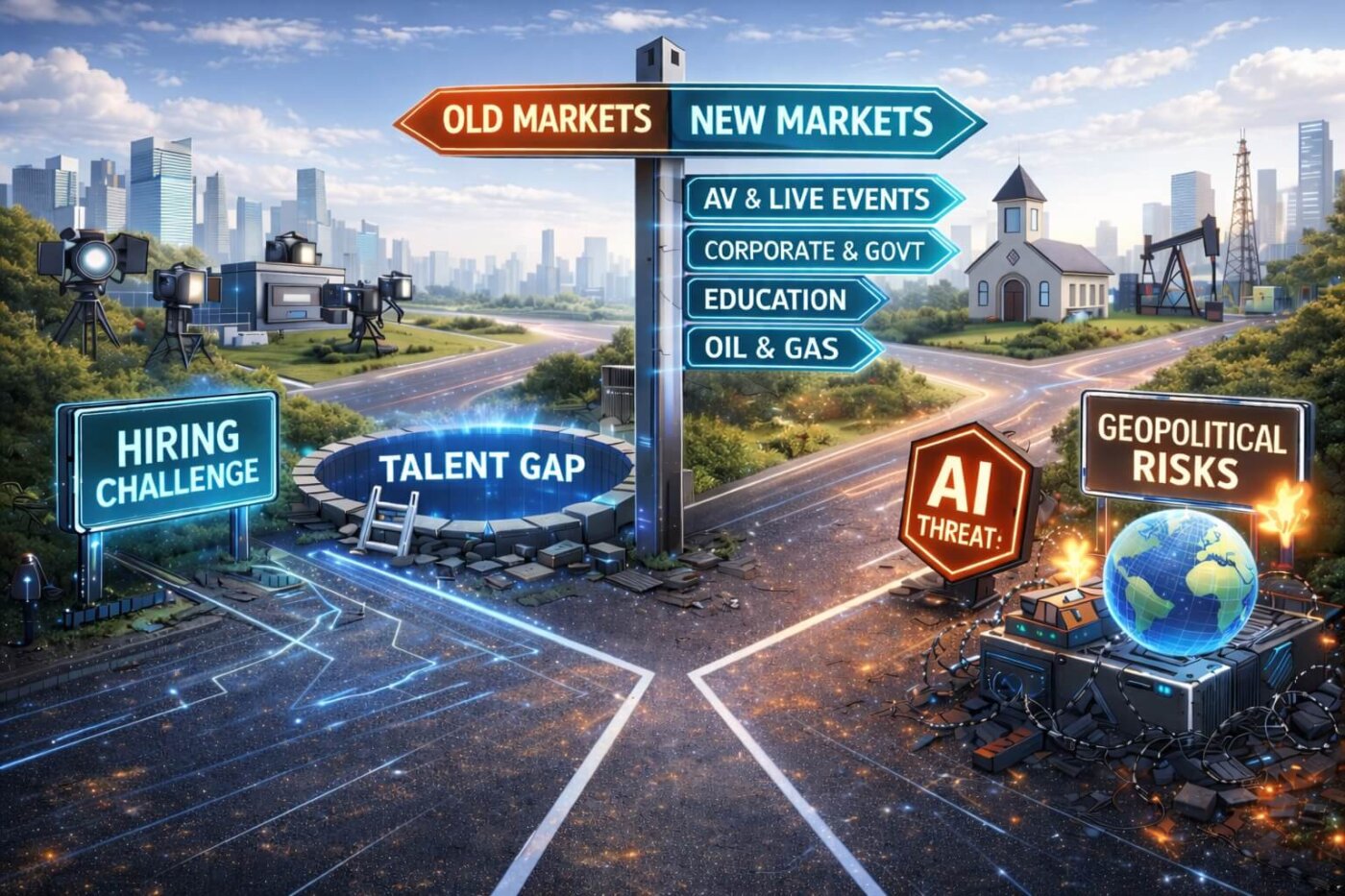
As a result, leadership teams have increasingly looked outward…
Live events
Corporate and enterprise
Houses of worship
AV systems integrators
Government and defence
Security and public safety
These are no longer ‘adjacent’ markets; they are strategic priorities. This is precisely why ISE has become such a critical event for vendors that historically focused their attention on IBC or NAB. Over the past year, I’ve seen a noticeable influx of companies attending ISE for the first time, not as observers, but with genuine commercial intent. For many, the show has shifted from a curiosity to a cornerstone.
ISE represents scale, diversity, and opportunity, but it also demands a different mindset. Success in the AV and enterprise ecosystem requires new routes to market, different buyer personas, and often a fundamentally different sales motion.
Talent strategy as a growth lever
From my vantage point in recruitment and advisory, this shift in vertical focus has driven a marked change in the types of conversations taking place. Increasingly, discussions are not about simply ‘adding headcount’, they are about re-architecting go-to-market strategies.
That includes:
- Redesigning sales structures to reflect new verticals
- Hiring sales leaders with experience beyond traditional broadcast
- Strengthening pre-sales, solutions engineering, and customer success functions
- Aligning product, commercial, and delivery teams more tightly
The organisations moving fastest are those treating talent as a strategic enabler, not a downstream consideration.
Looking into 2026, this evolution will continue. The AV landscape offers enormous opportunity, but it also introduces uncertainty. The rules are different. Buying cycles change. Partnerships matter more. Execution becomes everything. And it’s clear that speed and decisiveness will separate the winners from the laggards.
The cost of slow decision-making
One area where many organisations still struggle is hiring execution. This time last year, I wrote about the importance of stakeholder alignment in interview processes and unfortunately, it remains a challenge. When hiring senior or strategically critical roles, scrutiny is both necessary and sensible. However, many processes have become overly complex, slow and risk-averse.
In too many cases, companies are chasing a “utopian” candidate who simply doesn’t exist.
The unintended consequence?
- High-calibre candidates disengage
- Momentum is lost
- Critical initiatives stall
In fast-moving markets, indecision is itself a decision, and often the wrong one. The most successful organisations I work with are those that balance rigour with urgency. They know what “good” looks like, they trust their judgement, and they move.
Embracing change
Despite the challenges, I remain bullish about the road ahead. Yes, our industry is undergoing significant change. Restructuring, downsizing and pivots are painful, and for some individuals, deeply personal. But change has always been part of the media and technology landscape. We have continuously evolved: from SD to HD, from hardware to software, from on-prem to cloud.
This moment is no different. Take AI, for example. Fear-driven narratives persist, but history tells us that those who embrace new tools, rather than resist them, gain the advantage. AI should not be viewed as a threat to talent, but as an amplifier of it.
The companies that will thrive are those that:
- Use AI to enhance productivity
- Empower their teams with better tools
- Improve the value they deliver to customers
Fear creates paralysis. Adoption creates opportunity.
Looking ahead
The convergence of broadcast, AV, enterprise and live experiences is accelerating. New markets are opening. New skill sets are required. New leaders will emerge.
For organisations willing to be bold, decisive and open-minded, the opportunity is significant. Moreover, in an environment defined by convergence and complexity, progress will come from clarity, speed and disciplined execution