

Type RT is the centrepiece of Calrec’s news at IBC 2026, extending the same IP ecosystem built around Argo and proving that broadcasters can start small and expand, without ever outgrowing the platform they invested in. Alongside it, Apex M6, brings a compact ST2110 1U modular I/O platform for audio interfacing, signal routing, bridging and network edge connectivity.
At IBC 2026, Calrec will unveil Type RT, a new 6, 12 and 18-motorised fader console range that condenses everything a broadcast audio desk needs into a compact, self-contained unit. The launch forms part of Calrec’s wider IP ecosystem on show, built around its established Argo consoles, giving broadcasters the freedom to build productions their own way, sizing their investment to the project.
Introducing Type RT – Calrec’s most compact all-in-one digital console
Built on proven Calrec technology, and suited to a wide range of applications, including stadiums/sports venues, radio stations, local TV/podcast studios, corporate events and houses of worship. Type RT combines the best of Calrec’s Argo and Type R platforms in a ready-to-use, self-contained console, making getting started with Calrec easier than ever. Everything a user needs is built in, including DSP, control processing, comprehensive I/O, monitoring and integrated USB audio connectivity. Created as an accessible entry point into the Calrec IP ecosystem, it’s ideal for users new to Calrec who want the confidence of proven broadcast audio performance in a straightforward, all-in-one unit.
Purpose-built for fast deployment, the compact, fanless tabletop console ensures silent operation, delivering professional live broadcast performance in environments where space, time and budget matter. Whether for smaller facilities needing a reliable, cost-effective solution, or larger operations looking to streamline workflows across multiple applications or remote setups, it provides a flexible platform that adapts to a range of production requirements.
Every model shares the same capability, I/O and licensing options, so users can choose the surface size that suits their needs and budget rather than compromising on performance.
Dedicated information and metering displays beneath each fader give clear, instant visual feedback, while the user-configurable control and monitoring panel adapts to how each operator likes to work. Up to 138 assignable buttons, 24 rotary encoders with dedicated displays, three ancillary displays and a 4-inch TFT screen with user-configurable meters put critical controls and status information exactly where they’re needed.
Calrec’s Medium Capacity Card delivers native ST2110 AoIP connectivity with full support for existing Calrec AoIP boxes; Dante is available via an optional card, MADI via a software licence.
Type RT combines optional True Control 2.0 for remote production and ImPulseV virtualised DSP in an ultra-compact form factor, bringing full Calrec capability to any location, whether that’s a remote production hub, flypack, OB vehicle or temporary control room.
Calrec Assist, the browser-based control interface, is included as standard, giving virtual faders, user-configurable metering and real-time, interactive access to the console from anywhere, so users can monitor, control and adjust their mix remotely. Calrec Connect and Calrec Configure are also included, covering network management, system configuration and status monitoring.
Large and small soft panels from the existing Type R line are fully supported, with one soft panel per 6-fader section as standard, adding further control where needed.
Launching Apex M6 – Small frame. Big possibilities
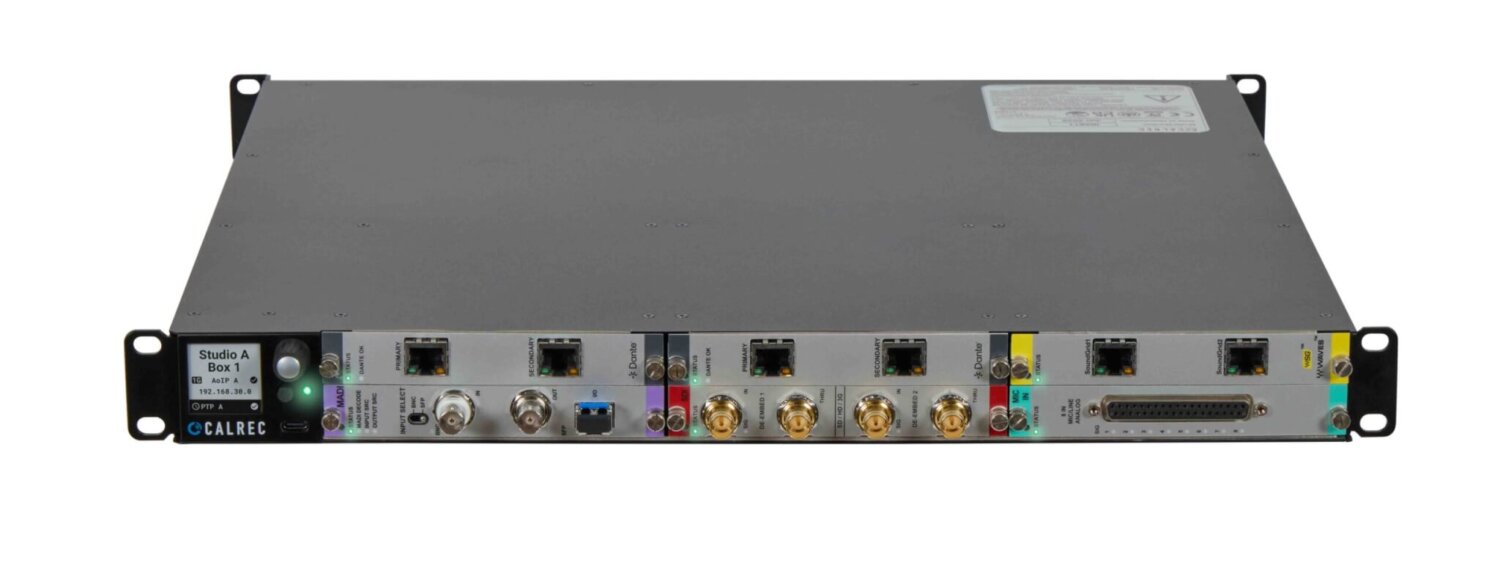
Calrec is unveiling Apex M6 at IBC 2026, a compact, cost-effective 1U modular I/O platform for audio interfacing, routing, bridging and network edge connectivity. Designed to expand and extend connectivity across broadcast audio infrastructures, Apex M6 supports ST2110-30, AES67, Dante, MADI, SDI, Waves SoundGrid AES3 digital formats and analogue workflows.
The platform can be deployed independently of Calrec consoles, making it an ideal solution for broadcasters transitioning to IP, expanding existing networks or integrating mixed-format environments. Designed with cost-efficiency and flexibility in mind, it combines six configurable module slots for a wide range of existing Calrec I/O cards, with two built-in MADI interfaces included, GPIO and redundant network connectivity, delivering a highly adaptable solution in a compact footprint.
Apex M6 works with Calrec’s full console range while opening opportunities in standalone conversion, virtualised workflows and multi-vendor environments. It’s 512 x 512 channel internal router allows any input to be sent directly to any output without patching signals back through the network, while NMOS-native operation ensures interoperability across multi-vendor ST2110 ecosystems. Requiring no DSP core, Apex M6 is equally suited to distributed deployments, from remote studios, venues and commentary positions to temporary flypack and pop-up productions.
Future proofing freedom
For years, broadcast facilities were built around one assumption: provision for the biggest project they might produce. That assumption no longer holds. As audiences fragment across streaming, social and FAST platforms and rights costs keep climbing, the advantage sits with the broadcaster who can choose the right production model for any given project.
Calrec will show how its IP-native ecosystem, with the award-winning Argo console range at its centre, puts that choice in broadcasters’ hands. Built to run on-prem, remote, virtualised, or connected through orchestration platforms such as Grass Valley’s AMPP and NEP’s Platform, Argo enables productions to be configured project by project. The commercial logic follows directly: the cost of the production should track the scale of the job, not the other way round.
Calrec’s virtual mixing engine ImPulseV now offers two new smaller DSP packages – 96 and 140 path configurations – alongside the existing 256-path option, all sharing the same full capability, including support for 5.1 and immersive audio up to 7.1.4. New licensing terms of one year, 12 weeks and four weeks lower the barrier to entry further, letting broadcasters scale as needed.
Calrec will preview a series of Argo and ImPulseV software enhancements at IBC 2026, reinforcing its commitment to the EBU’s Dynamic Media Facility project, and giving broadcasters greater freedom to shape their infrastructure around their own priorities.