


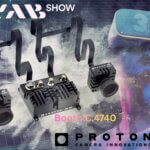



Proton Camera Innovations GmbH (Booth C.4740) is set to demonstrate the immersive potential of its miniature camera ecosystem at the 2026 NAB Show, showcasing how its ultra-compact form factors are pushing beyond traditional sports broadcasting into the realm of stereoscopic 3D cinematography.
On the booth, Proton will be demoing their PROTON FLEX and 4K FLEX cameras and explaining the ways in which their unique design opens up new creative potential for film makers, highlighting particularly the integral nature of these cameras to an existing 3D production process, currently being utilised by one of the most significant directors of the 21st century. While details of the production remain under wraps, Proton’s involvement underscores the growing demand for miniature, synchronisable camera systems capable of delivering true stereoscopic depth in narrative environments.
The ability of PROTON cameras to deliver seamless 3D imagery rests on two central propositions, the first of which is the ability to combine a pair of cameras with a single Camera Control Unit. By pairing two PROTON Flex or two PROTON 4K Flex units and a CCU, Proton achieves frame-accurate synchronisation between both sensors at every frame, crucial to the delivery of seamless 3D. Alongside this, it is the exceptionally small and lightweight form factor of PROTON cameras which allows them to excel in the delivery of 3D imagery. Not only does their negligible weight allow them to be mounted on a person or rig without impeding movement, but their small size allows them to be mounted using either a side-by-side or mirrored arrangement, at a distance which closely approximates that of human eyes, thus far more accurately replicating true 3D perception. This is something which simply cannot be achieved with standard-sized broadcast cameras.
As an additional benefit, PROTON’s FLEX cameras slot into a user’s 3D workflow in a much simpler and streamlined manner, by virtue of the fact that power delivery is consolidated, and colour shading and exposure can be adjusted from the master camera and automatically perpetuated throughout the rig. This streamlined approach means production teams can focus on creative execution rather than technical wrangling.
The application of PROTON’s technology in high-end cinematography represents a natural evolution of the creative freedom that miniaturisation enables – a creative freedom which Proton have pushed particularly in the field of live sports, where cameras have been mounted on drones, rally cars, helmets and goal posts or tennis nets, delivering a broadcast-grade view from spaces where conventional cameras simply cannot go. Now, with their developing 3D capability, Proton pushes this creative potential into the realm of cinema, placing viewers directly inside a scene with a full sense of depth and immersion.
Alongside this 3D potential, visitors to Booth C.4740 can explore the PROTON CAM – the smallest broadcast camera currently on the market – as well as the 4K-capable PROTON 4K, the zoom-integrated PROTON Zoom, the weather-sealed PROTON Rain, and the newly launched PROTON PRO with its integrated global shutter and professional connectivity. Together, the range provides both flexibility and specificity, allowing users to tailor their camera choice to their exact creative and operational needs.
Speaking for Proton Camera Innovations, CEO Marko Hoepken said: “When we developed the Flex architecture, we knew the ability to separate lens from body would open creative doors. But even we didn’t anticipate that it would become the foundation for a 3D ecosystem being adopted by one of the most ambitious film productions in years. The fact that two Flex cameras can share a single CCU – synchronising at the frame level, sharing colour metadata, drawing from one power source – shows again how technological innovation drives creativity just as much as creativity drives technical innovation”.