




The Media & Entertainment (M&E) industry has always thrived on creativity, but today, it’s equally powered by data and technology. Modern tools can move content seamlessly across platforms, connecting fans around the globe and extending a title’s lifecycle through discovery, localization, and engagement.
However, achieving true global reach creates a new level of complexity. Media companies now juggle vast catalogs across streaming platforms, each governed by their own rights and licensing agreements. Each asset, whether a movie, episode, or trailer, carries both cost and revenue potential. Yet too often, key information like metadata, rights, financial details, or audience analytics, sits trapped in a patchwork of disconnected departmental silos.
These fragile ecosystems are hardly ideal foundations for managing library optimization and monetization, heightening the strategic business need for unified views of content availability and operational performance.
From Creativity to Clarity
M&E success is no longer exclusively a result of good storytelling. It’s now a matter of how quickly and intelligently an organization can act on the data attached to its content.
Without a consolidated “command center,” media leaders can’t fully see the financial or operational impact of their decisions. Integrating data sets for rights, licensing, financials, audience insights, and metadata into a unified framework allows companies to make faster, smarter, and more profitable decisions about launching a FAST channel, entering new markets, or re-licensing a trending title.
Many studios unknowingly duplicate content storage or processing simply because of fragmented data oversight. Centralized visibility exposes these inefficiencies, helping teams eliminate redundant workflows, control costs, and identify manual tasks ripe for automation, such as mastering, conformance, and localization.
Automation Upstream
The next step is applying this level of automation earlier in the chain, during asset selection, source verification, and versioning. Unifying title metadata, rights, and performance data enables “exception-based” management, where human input is needed only when anomalies arise. This shift lets teams focus on strategy and creativity instead of manual administration, augmenting rather than replacing human expertise.
Change Starts with Connection
The biggest obstacle to navigating this change is often culture based rather than technology driven. Large organizations can be slow to adapt, attempting massive overhauls instead of incremental improvements. Vendor-agnostic platforms that serve as a “single pane of glass” across rights, operations, and finance bridge these gaps, making insights accessible across the enterprise.
Partnerships with integration-focused providers help break down silos, automate workflows, and accelerate innovation, connecting business strategy directly to execution.
A Practical Example: Crunchyroll and TMT’s Focus Platform
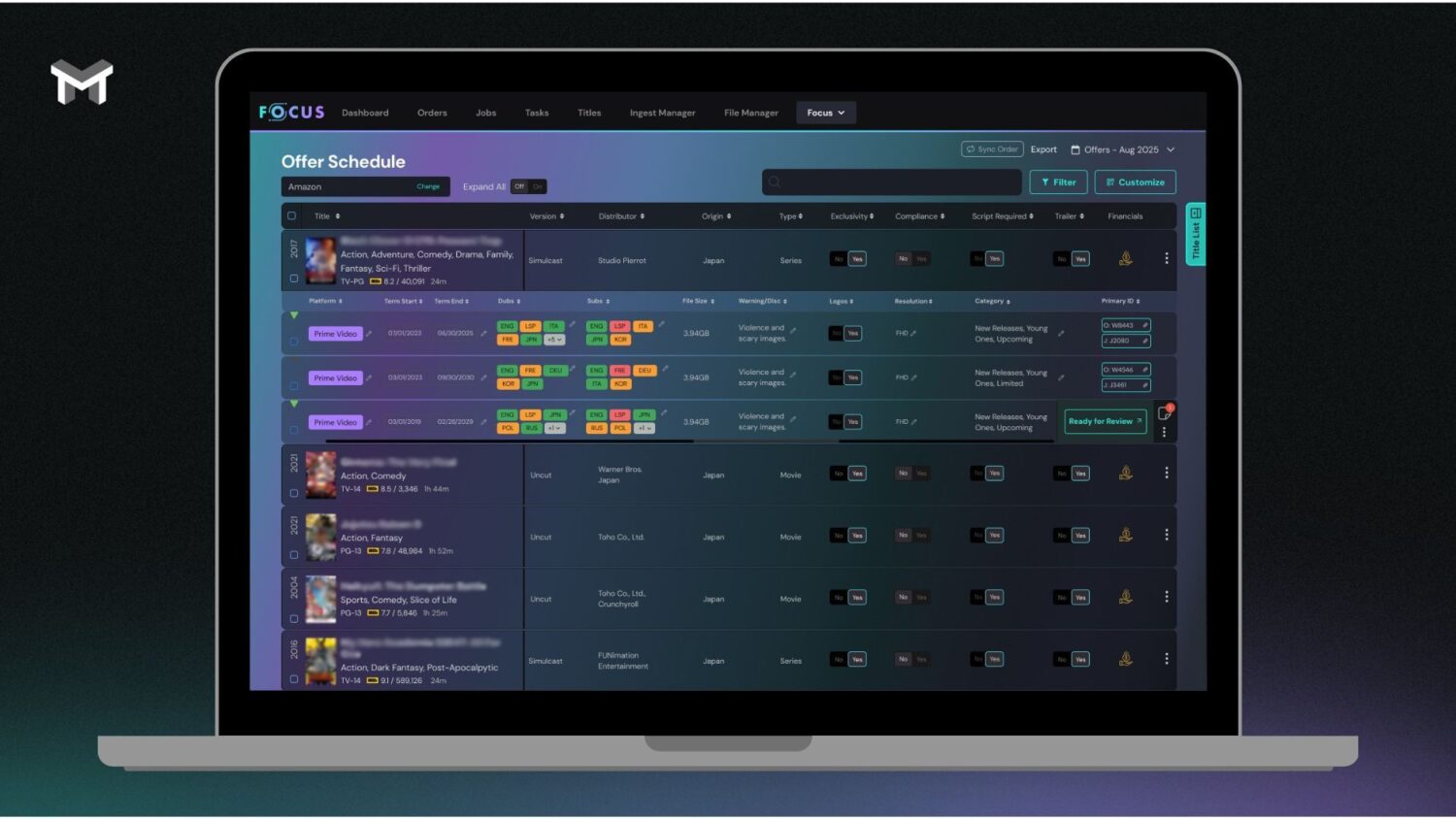
As the global leader in anime content, streaming, and fandom, Crunchyroll leverages Focus to enhance cross-functional collaboration among Programming, Content Operations, and Distribution. The software solution strengthens communication and alignment across these groups, increasing opportunities to streamline the content supply chain.
Focus gives teams real-time visibility across the entire content library by analyzing programming strategy and aligning it with inventory availability. This drives localization planning, informs the overall content delivery process, and optimizes operational costs – enabling faster, smarter decisions. As they will continue to grow globally, having this depth of insight and automation is essential to effectively reach their fans and support dynamic regional strategies.
By centralizing data on content availability, localized assets, and readiness, Focus provides a solution that Crunchyroll can utilize to efficiently align content with regional demand.
For any modern media business, visibility equals velocity. Leaders who fail to modernize risk being constrained by outdated, disconnected systems that slow decision making and profitability.