






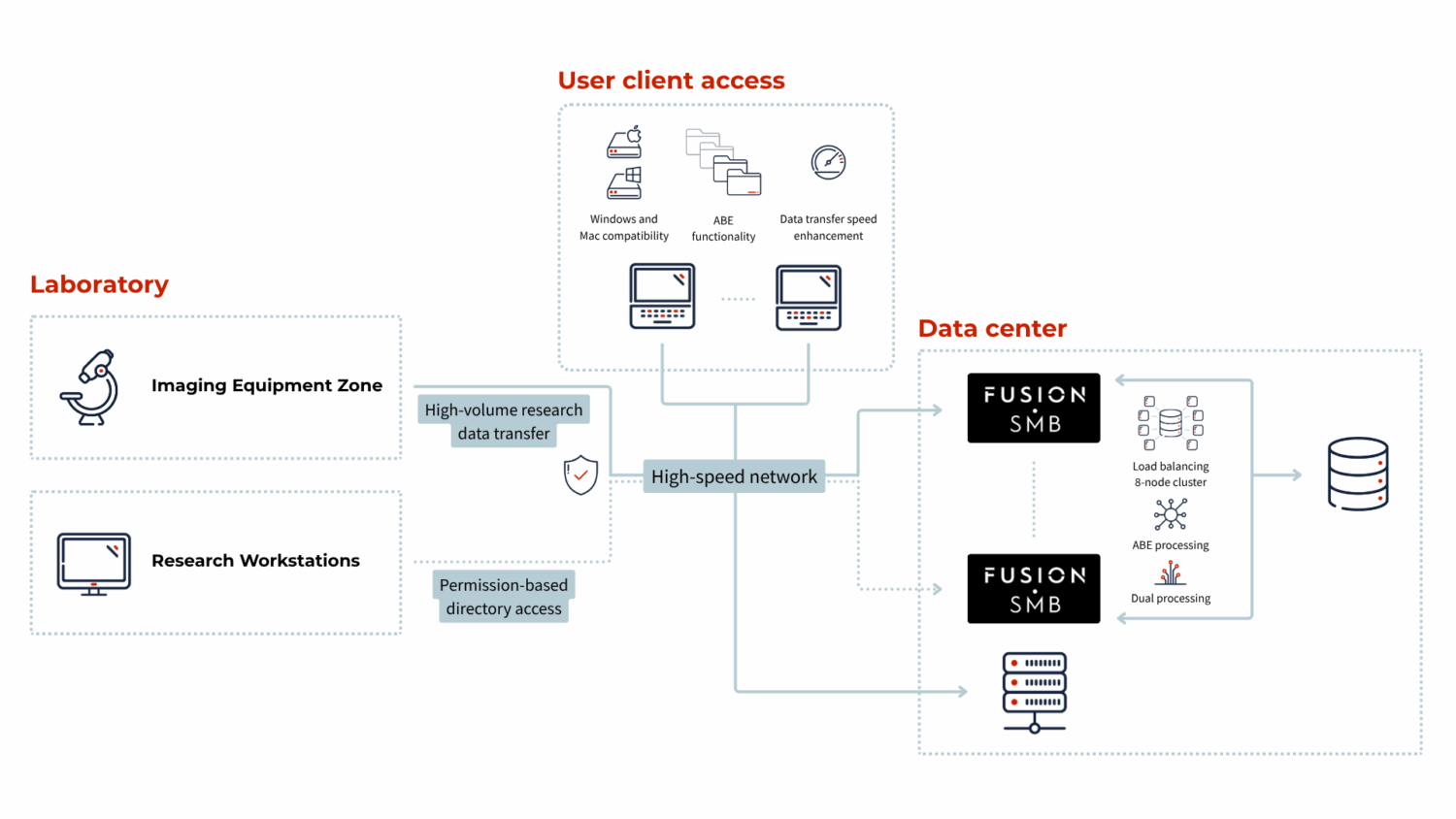
Tuxera, a leading provider of quality-assured file systems and networking technologies, announces that Albert Einstein College of Medicine has successfully implemented Tuxera Fusion SMB to optimize data access and sharing across its extensive research infrastructure. The premier research-intensive medical school in New York previously faced significant challenges with their existing Samba-based SMB (Server Message Block) solution, where network bottlenecks were impacting researchers’ ability to access and transfer data efficiently, particularly affecting their work with large reference files and research datasets. With over 6 billion files totaling approximately 18 petabytes of data, the institution required a more robust solution that could handle their extensive research data infrastructure without compromising on performance or security.
“Moving to Tuxera was a no-brainer,” says Shailesh Shenoy, Assistant Dean for Information Technology at Albert Einstein College of Medicine. “Having a solid technical solution to address our data sharing needs is essential. This is about enabling our researchers to succeed – we need things to work well all the time because you never know when inspiration will strike. If systems aren’t working in that moment, opportunities could be lost.”
The medical school manages data from an extensive array of sophisticated imaging equipment, including Optical Coherence Tomography (OCT), Diffuse Optical Tomography (DOT), Super-resolution Microscopy, Raman Spectroscopy, Photoacoustic Imaging, Endoscopy, and X-ray systems. These devices generate ultra-high-resolution images and videos, requiring a robust system for storing and accessing research data. The institution needed a solution that could handle concurrent access to large reference files while maintaining data integrity and security.
The implementation, running on an IBM Storage Scale platform managed by partner Data In Science Technologies (DST), has delivered significant improvements across Einstein’s research infrastructure. Replacing the standard Samba implementation with Tuxera Fusion SMB achieved a considerable improvement in data transfer speeds, with the ability to achieve near line-speed data transfer using RDMA (Remote Direct Memory Access). Active-active clustering across eight servers enables seamless failover with zero disruption to users, while significant improvements in Access-Based Enumeration (ABE) performance ensure users only see relevant directories while maintaining security. The streamlined infrastructure now provides a single namespace implementation across two data centers, supporting over 1,100 students and 1,500 active faculty members.
“For us, this is about making infrastructure transparent to our researchers,” adds Shenoy. “They shouldn’t have to think about it. With Tuxera Fusion’s clustering capabilities, we can perform scheduled maintenance or updates without any impact on our users. Even if we need to take a data center offline, nobody would notice the difference.”
The solution supports Einstein’s commitment to data privacy and security in their research programs. The implementation allows the institution to maintain strict control over sensitive research data while ensuring it remains readily accessible to authorized users.
“At Tuxera, we understand that every millisecond of data access matters in research environments,” says Antti Alila, VP of Enterprise Solutions at Tuxera. “By bringing our deep expertise in SMB protocol optimization and networking technologies to Einstein, we’re helping advance critical medical research that impacts human health. Our commitment goes beyond just providing software – we’re dedicated to ensuring researchers can focus entirely on their groundbreaking work without technology standing in their way.”