


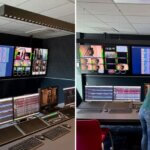



Edith Cowan University (ECU) in Perth, Western Australia is renowned for its strong focus on industry-aligned teaching, practical learning, and innovation in journalism and broadcast media. Recently, the university has developed new broadcast facilities at its City Campus designed to function as an education-first environment while mirroring real-world production standards. ECU’s mission is to provide students with hands-on experience, equip them with contemporary production skills, and foster creativity, collaboration, and critical thinking.
Delivered in collaboration with Lawo’s partner PAT and systems integrator Diversified, who were responsible for overall system delivery and integration, with Techniq Media acting as the principal broadcast consultant, the installation centers on Lawo’s HOME management platform for IP infrastructures and the overarching broadcast control and workflow solution VSM (Virtual Studio Manager), working in tandem to deliver a fully integrated, future-ready broadcast environment. The mc²36 audio production console completes the core control and audio ecosystem, enabling students to train on workflows and technology used in professional broadcast facilities. From the outset, ECU’s requirement for the new infrastructure was to create a studio environment that could be prepared quickly and reliably for teaching, rehearsal, and production use, while remaining accessible to users with varying levels of technical experience.
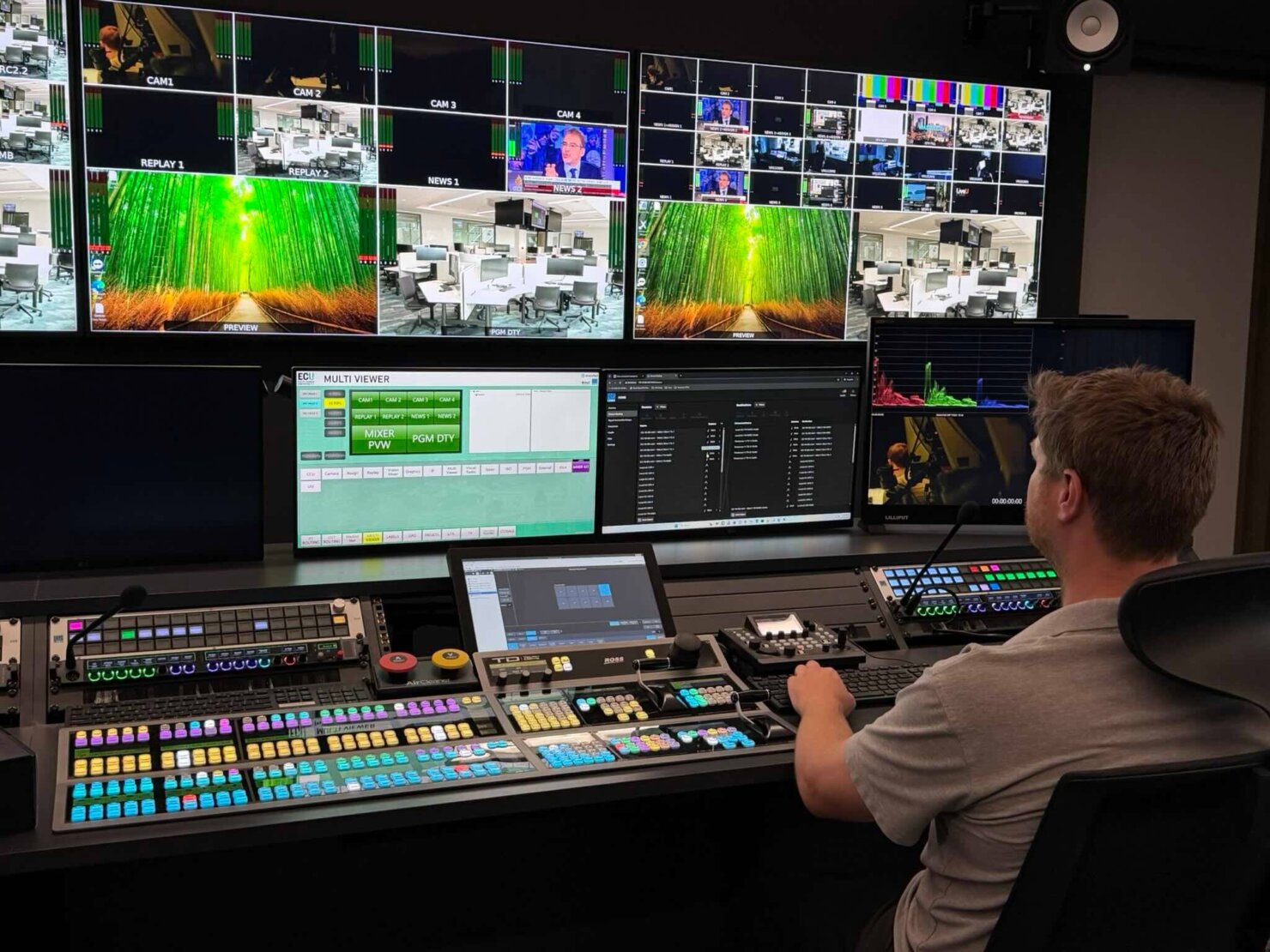
“The studio now resembles a NASA control room, delivering capabilities that will be the envy of our colleagues in professional news or production companies,“ says Andrea Burns, Academic Lead of Screen and Media at Edith Cowan University.
HOME serves as the foundation for the facility’s Audio-over-IP infrastructure, providing centralized discovery, management, security, and resource allocation across the mc²36 console and networked audio devices. By managing AoIP resources transparently and reliably—including support for ST 2110, AES67, and RAVENNA—HOME allows students to work with advanced IP audio workflows without needing deep technical knowledge, while giving lecturers a stable and predictable environment for teaching.
Building on HOME, VSM acts as the overarching broadcast control and orchestration layer, unifying the studio’s multi-vendor technology stack. Video routing is handled by an Ultrix FR5, while IP video transport and timing are provided via Riedel Horizon and Riedel Micron. VSM consolidates device control, routing logic, tally management, and studio state transitions into a single operational interface. By integrating directly with HOME-managed audio resources, it ensures that all elements of the facility—audio, video, and peripheral devices—behave as a coherent system, while presenting lecturers and students with clearly defined operational modes aligned to teaching workflows.
The mc²36 console provides a professional, all-in-one audio production environment. Powered by A__UHD Core processing technology, the console delivers 384 DSP channels, 864 I/O channels, and native IP support for all major AoIP standards. Its user-centric interface—including color TFT fader displays, touch-sensitive rotary encoders, Full-HD touchscreens, and loudness metering—offers students a visually rich, highly intuitive operating experience, closely mirroring major broadcast facilities.
Throughout the facility, LUX (Lawo Unified Experience) principles ensure a consistent, role-based user experience. VSM desktop interfaces and dedicated 50-key panels are mapped to studio presets and operational modes—such as teaching, production, or reset—allowing lecturers to prepare the control room with a single action. This “push-button studio readiness” reduces cognitive load, minimizes errors, and maximizes focus on practical learning outcomes.
For ECU, the combination of HOME, VSM, and mc²36 aligns perfectly with its educational objectives: providing authentic hands-on experience, fostering professional skills in modern broadcast workflows, and creating an accessible, structured learning environment. Students gain early exposure to IP-centric production infrastructures, while lecturers benefit from predictable, repeatable workflows. With Lawo technology at its core, ECU now operates a broadcast training space that is both professional-grade and purpose-built to support its mission of preparing the next generation of media professionals.
Burns concludes: “It’s the fact the team worked with one eye on technical precision and the other on student potential that made this collaboration a real success. And they’re as excited as we are by the possibilities this system creates for our students.”