

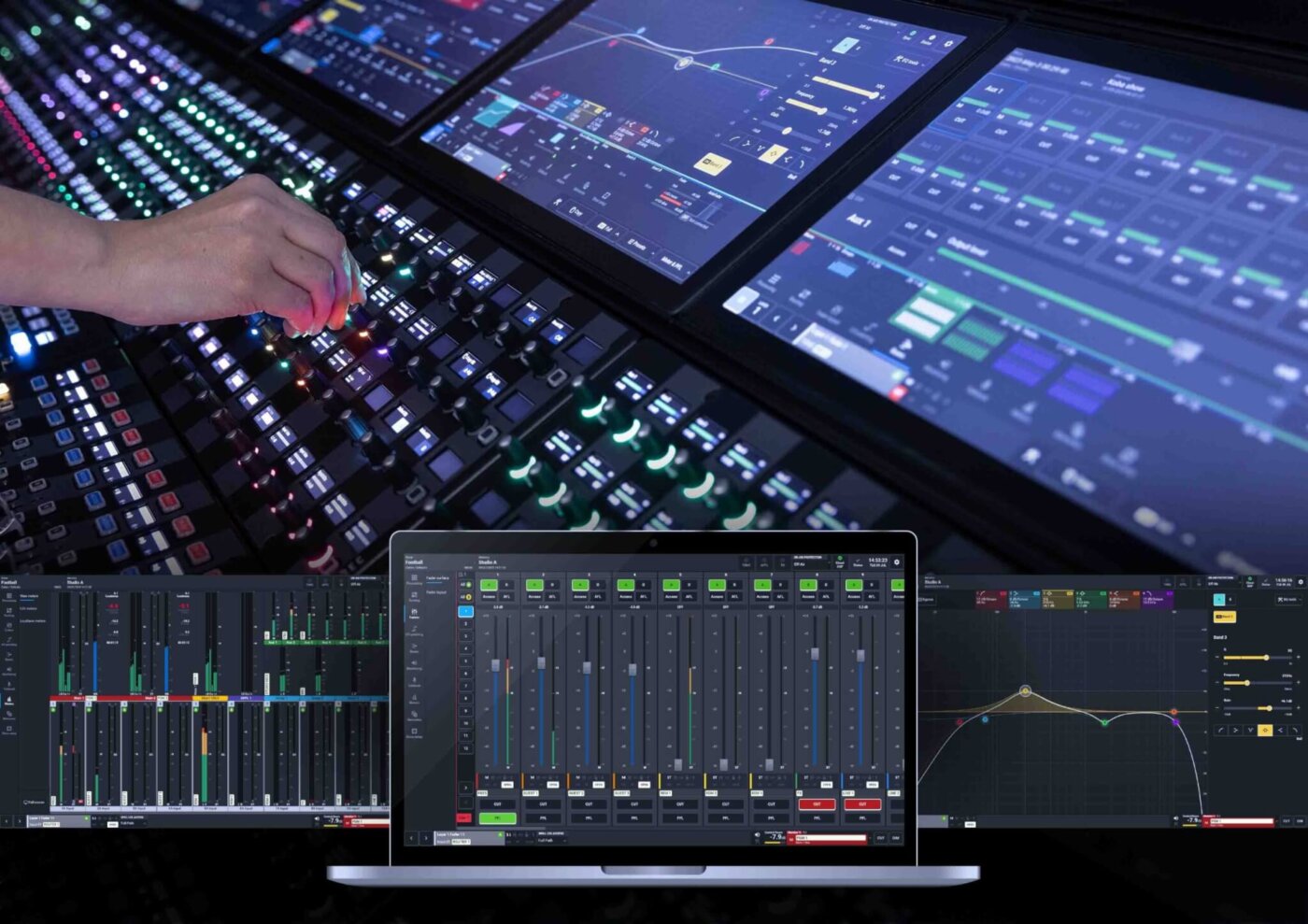
At the heart of the installation is Calrec’s technology partnership with Grass Valley’s AMPP, which was announced in April 2026
DMC Production has turned to Calrec in its quest to redefine outside broadcasting with a flexible approach to live production that reverse engineers the conventional broadcast workflow
DMC Production has also installed a 48-fader Calrec Argo M console at its remote production facility in Munich, Germany
Calrec’s ImPulseV Virtualised Audio Mixing Engine plays a key role in the vehicles’ software-based architecture, replacing the traditional hardware-heavy OB model
DMC Production’s AR 1 and AR 2 units reverse the conventional OB workflow, keeping all production-critical processing at the venue while operators work remotely. Built around Grass Valley’s AMPP cloud-native platform, Calrec’s ImPulseV virtualised DSP and 48-fader Argo M console deliver an agile audio network at the heart of this ground-breaking production architecture.
DMC Production has turned to Calrec in its quest to redefine outside broadcasting with a flexible approach to live production that reverse engineers the conventional broadcast workflow. Working in collaboration with Calrec and Grass Valley, DMC Production has unveiled AR 1 and AR 2 – two identical, scalable software-defined remote production vehicles that represent a unique outside broadcast framework the company describes as “reverse remote production.” The units were designed and delivered by systems integrator Broadcast Solutions.
Calrec’s ImPulseV Virtualised Audio Mixing Engine plays a key role in the vehicles’ software-based architecture, replacing the traditional hardware-heavy OB model. The guiding principle is simple: all production-critical processing happens at the venue – video switching, replay, signal processing, multiviewers, recording and audio mixing, all running within a pure cloud-native Grass Valley AMPP environment with remote operation from any of DMC Production’s broadcast centres.
By keeping the raw production feeds at the venue rather than backhauling them to a central facility, the remote vehicle becomes the local production edge. The major benefit is bandwidth efficiency; a large multi-camera production can be handled over a lightweight 100 Mbit/s internet connection. In these environments, audio can be challenging, but DMC Production has worked with Calrec to develop an audio network that not only connects everything seamlessly but delivers low latency control with a familiar interface.
Jens Envall, DMC Production’s Chief Innovation Officer, says this is the first step in a larger deployment model for DMC Production. “The aim is not just to build one or two vehicles, but to establish a repeatable and scalable production concept where software, IP connectivity and professional broadcast control surfaces work together in a practical live production environment.”
At the heart of the installation is Calrec’s technology partnership with Grass Valley’s AMPP, which was announced in April 2026. In the first phase of the integration, DMC Production is using Calrec’s ImPulse1 processing core until the fully integrated ImPulseV AMPP platform comes online, but Envall is already planning for more native control integration within the AMPP environment.
DMC Production has also installed a 48-fader Calrec Argo M console at its remote production facility in Munich, Germany. The ecosystem is connected and managed using Calrec’s remote production capability, True Control 2.0, enabling seamless integration between the Argo M control surface and the OB units across any geographic boundaries. It means an audio engineer can manage the entire mix remotely across a low-latency connection while production-critical processing remains in the AMPP-based remote production vehicles at the venue. Each vehicle also includes Calrec Type R for local monitor and in-ear mixing, together with the required IP I/O infrastructure.
Envall says the Argo M surface stands out because it gives the audio engineer the right level of control for complex live productions. “The physical faders, layout and operational approach are very important for sports and fast-moving live events. True Control 2.0 is also critical because it allows us to operate the audio environment remotely while maintaining a familiar and responsive workflow for the engineer. That is a key part of making this production model practical.”
The Argo M’s versatility reflects the breadth of content DMC Production is delivering. The company produces a broad mix of live sports, studio, entertainment and event-based coverage. “The demand from the market is changing quickly,” says Envall. “Customers want high-quality production, but they also want more flexibility, shorter setup times and more efficient use of resources.
“Many rights holders and broadcasters no longer think only in terms of one main programme feed. They want clean feeds, ISO feeds, highlights, digital clips, social-first versions, venue feeds and sometimes additional language or commentary options. Because the vehicle can generate clean programme feeds locally, we can create a more flexible output structure from the venue. That can then feed traditional broadcast, OTT, social media, rights holders, venue screens or partner platforms.”
Envall concludes, “This is not a standard installation where we are simply replacing one traditional audio console with another. We are building a new workflow, and that requires a close dialogue between engineering, product and operational teams. Calrec has been very supportive throughout the project. That ongoing relationship is important because this is the first step in a scalable model. We need partners who are willing to develop with us, not only supply equipment.”
Calrec Regional Sales Manager, Anthony Harrison says, ” DMC Production’s approach to dynamic remote production is highly innovative and is testament to the company’s adaptability, in tandem with Calrec’s scalable and flexible audio ecosystem. It is the first step in establishing a repeatable production concept where software, IP connectivity and control work together in a practical live production environment.”